When to Use Tinnitus Relief App: Sleep, Work, Calls & Travel



Tinnitus doesn't pause for bedtime, a work deadline, or a Zoom call. This guide explains why each situation affects tinnitus differently — and gives you the exact sound therapy settings to try in each one. Each setting works in the Tinnitus Relief App, which keeps playing through calls, Zoom, and a locked screen.
🌙 Sleep 💼 Work 📞 Calls ✈️ Travel 🏠 Home 🚨 Spikes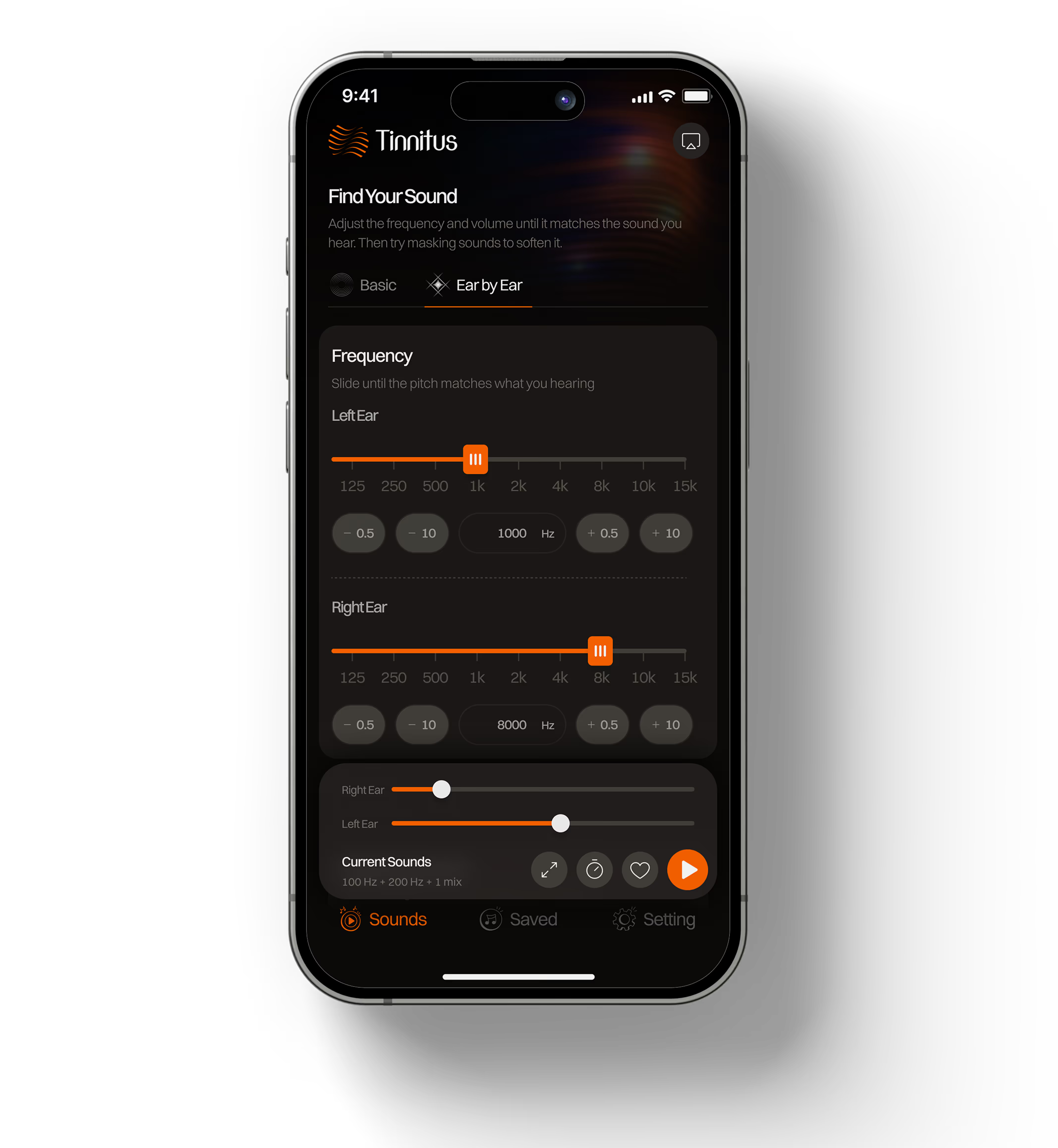
Why Tinnitus Feels Different at Night, at Work, and in Transit
Tinnitus volume doesn't change much during the day. What changes is how much your brain notices it.
Daytime noise — conversations, traffic, a coffee machine — competes with the ringing. Your brain has other signals to process. At night, in a quiet room, that competition disappears. Quiet environments are widely reported as making tinnitus more noticeable, and sound enrichment is one of the most consistently recommended self-management strategies in the clinical literature.
Stress amplifies it further. When your nervous system is activated — a difficult meeting, a tight deadline, a long flight — your brain scans for the tinnitus signal more frequently. Reducing stress and adding gentle background sound are among the most commonly recommended approaches.
This is why a single sound therapy setup doesn't work for every moment. Sleep needs gentle, time-limited masking. Work needs barely-there background sound. Calls need sound that doesn't interrupt conversation. The settings below are starting points, not prescriptions. Adjust to what feels right. Individual results vary significantly.

Falling Asleep With Tinnitus
Sleep is the most commonly reported problem for people with tinnitus. The cycle is compounding: poor sleep tends to make tinnitus feel worse, and worse tinnitus tends to disrupt sleep further.
As your bedroom goes quiet, the contrast between your tinnitus and the environment increases sharply. Sound therapy at night works by reducing that contrast — giving your brain another signal to focus on so the ringing stops dominating attention.
Published clinical guidelines recommend that masking sounds should not completely cover the tinnitus. Partial masking is more consistent with long-term habituation. Consistent daily exposure over weeks to months is the factor most associated with reported improvement.
A pure sine tone at your matched frequency can be alerting rather than calming. Broad-spectrum sounds like rain or pink noise feel more natural and are less likely to keep your brain in analytical mode. Save frequency matching for daytime use.
Tip: Keep the same sound and volume for at least 7 consecutive nights before adjusting. Consistency helps your brain treat the sound as a sleep cue. → Safe sound therapy guide

Staying Focused at Work With Tinnitus
Concentration problems are one of the most reported functional impacts of tinnitus. The ringing competes with cognitive tasks — especially reading, writing, or any work requiring sustained attention.
You don't need heavy masking here. A light, consistent background signal is enough — just enough to reduce the contrast between tinnitus and the office environment. Think of it like background music in a café: present but not distracting.
Pink noise can work well for extended work sessions because it emphasises lower frequencies more than white noise, making it feel softer over hours of listening. Some people prefer coffee shop ambience for its irregular, natural rhythms.
If tinnitus feels particularly intrusive, adding your matched frequency at very low volume (10–15%) can give more targeted relief. It fills the exact frequency band your tinnitus occupies, reducing contrast more efficiently than broadband noise alone. Turn it off if it becomes distracting.
Tip: Pair sound therapy with a Pomodoro timer — 25 minutes of focused work, then a 5-minute break. Structured breaks prevent frustration from building up. → Tinnitus & stress guide

Sound Therapy During Calls, Zoom, and Teams
This is the situation that inspired the app.
When someone with tinnitus joins a video call, the ringing doesn't stop. Between sentences, during pauses, while listening — tinnitus fills every silence. Most apps pause the moment another app uses audio. Your sound therapy stops exactly when you need it most.
Tinnitus Relief App was built to solve this. Background play keeps your selected sound running during phone calls, Zoom, Teams, Google Meet, and FaceTime. The other person hears nothing different. You hear steady relief underneath the conversation.
The app uses an audio mixing mode that layers sound therapy underneath other audio sources instead of competing with them. This is why you can take a call, join a meeting, or play a YouTube video — and the masking never stops. This feature is free for all users. No subscription required.
Tip: Start playing sound therapy 2–3 minutes before your call begins. This gives your brain time to settle into the masking before you need to concentrate on conversation.
Every other app we tested stopped playing during phone calls. This one was built to never stop.
Background play during calls, meetings, and multitasking is free. No signup, no trial, no subscription required.
Try Background Play Free →
Managing Tinnitus While Travelling
Airplane cabin noise, train vibrations, and road hum generate sustained low-frequency sound that doesn't mask tinnitus — it just adds to overall auditory stress. Your brain processes both engine noise and the ringing, leading to faster fatigue.
This is the one situation where stronger masking makes sense. Brown noise — deeper and richer than white or pink — matches the rumble of engines and helps reduce the overall auditory load. The frequency tone can also be useful here, adding precision masking at your specific tinnitus pitch.
All sounds work 100% offline. Download before departure. No Wi-Fi or mobile data needed.
Brown noise concentrates energy in lower frequencies, overlapping with engine noise. This creates a more uniform sound environment, reducing the contrast between engine rumble and higher-pitched tinnitus. White noise also works — use whichever feels most comfortable.
Tip: Bring noise-isolating earbuds. They reduce baseline engine noise so your masking can be set lower — less ear fatigue on long flights. → White, pink & brown noise explained

Gentle Background Relief for Daily Activities
At home — reading, cooking, watching TV — you may not need active masking. But complete silence can let the ringing creep back into focus, especially during quieter moments.
The goal here is habituation support. Maintaining a very gentle background sound throughout daily activities reduces how often your brain rediscovers the tinnitus. This is consistent with the principle behind Tinnitus Retraining Therapy (TRT), which uses low-level broadband noise to support long-term neural adaptation.
Habituation develops over weeks and months. The key is regularity, not intensity. Individual results vary significantly.
Tip: Play through a phone or Bluetooth speaker instead of headphones. This gives your ears a break while still filling quiet rooms with enough texture to prevent tinnitus from dominating. → How sound therapy works

When Your Tinnitus Suddenly Gets Louder
Tinnitus spikes — sudden, temporary increases in volume — are common and often triggered by stress, noise exposure, lack of sleep, or no identifiable reason at all. They are distressing, but almost always temporary.
The immediate instinct is to panic. This is counterproductive. Stress is both a trigger and an amplifier of tinnitus. The spike-anxiety cycle is real and widely documented in clinical literature.
Your response during a spike: sound therapy on, breathing slow, expectations calm. The goal is not to eliminate the spike immediately — it's to prevent the anxiety response from extending it.
During normal use, partial masking promotes habituation. During a spike, the priority shifts to short-term relief. Slightly louder masking provides faster reduction in perceived contrast. Limit this to 10–15 minutes, then return to normal levels. Extended loud masking can cause auditory fatigue.
Tip: Pre-save a "spike" preset so you don't have to think about settings when you're stressed. The fewer decisions during a spike, the faster your nervous system calms down. → Tinnitus & stress guide
Quick Reference: Settings by Situation
Save this table or screenshot it for quick access.
| Situation | Sound | Freq. Tone | Volume | Timer |
|---|---|---|---|---|
| 🌙 Sleep | White (free) / Rain or Pink (Premium) | OFF | ~20% | 60–90 min |
| 💼 Work | White (free) / Pink or Café (Premium) | Optional | ~15–20% | Continuous |
| 📞 Calls | White Noise (free) | OFF | ~10–15% | Continuous |
| ✈️ Travel | White (free) / Brown (Premium) | ON | ~25–30% | 15 min loops |
| 🏠 Home | White (free) / Forest, Fireplace (Premium) | Optional | ~10–15% | Continuous |
| 🚨 Spike | White Noise (free) | ON | ~25–30% | 10–15 min |
Starting points based on published sound therapy principles. Adjust to what feels right for you. Individual results vary significantly.
Frequently Asked Questions
Can a tinnitus app cure tinnitus?
No. No app can cure tinnitus. Tinnitus Relief App is a sound therapy tool that helps manage symptoms by reducing the perceived contrast between tinnitus and your environment. Published studies suggest consistent sound therapy may reduce distress over time, but individual results vary. This is not a medical device. If your tinnitus is sudden, one-sided, pulsatile, or accompanied by hearing loss, dizziness, or pain, see a healthcare professional.
Does tinnitus actually get worse at night?
Tinnitus doesn't usually get physically louder at night. It becomes more noticeable because environmental noise drops and the brain has fewer competing signals to process. Sound therapy addresses this by maintaining gentle background sound through the night.
Can I use the app during Zoom or Teams meetings?
Yes — this is the app's core feature. Sound therapy keeps playing during Zoom, Teams, Google Meet, FaceTime, and regular phone calls. The other person hears nothing different. This feature is free.
How long until I notice improvement?
Some people report immediate comfort during active use. Longer-term habituation typically develops over weeks to months. Consistency matters more than session duration. Individual results vary significantly.
Which types of tinnitus does the app help with?
The app is designed for subjective tinnitus — ringing, buzzing, hissing, humming, and similar sounds. It supports frequency matching from 125 Hz to 15,000 Hz. It is not designed for pulsatile tinnitus, which pulses with your heartbeat and should be evaluated by a doctor.
Is it safe to listen to masking sounds all day?
At comfortable volumes, extended use of broadband masking sounds is generally considered safe. Most sound therapy operates at 10–30% device volume. Take breaks if your ears feel fatigued. This is general information, not medical advice.
Should I use headphones or a speaker?
Both work. Headphones provide more precise masking and are necessary for frequency matching. Speakers are better for extended home use and give your ears a break. For sleep, many people play through a phone speaker on the nightstand.
What's included for free vs. Premium?
Free: background play during calls and multitasking, white noise, frequency matching, offline use, no signup. Premium ($39.99/year — currently $29.99 for the first year — or $49.99 lifetime): 44 therapeutic sounds, sleep timer with fade-out, per-ear frequency control, unlimited presets.
Sources
- Jastreboff P.J. (1990). Phantom auditory perception (tinnitus): mechanisms of generation and perception. Neuroscience Research 8(4):221–254.
- Baguley D., McFerran D., Hall D. (2013). Tinnitus. The Lancet 382(9904):1600–1607.
- Tunkel D.E. et al. (2014). Clinical Practice Guideline: Tinnitus. Otolaryngology–Head and Neck Surgery (AAO-HNS) 151(2_suppl):S1–S40.
- Cima R.F.F. et al. (2019). A multidisciplinary European guideline for tinnitus: diagnostics, assessment, and treatment. HNO 67(Suppl 1):10–42.
- World Health Organization (2021). World Report on Hearing. Geneva: WHO.
Sound Therapy for Every Part of Your Day
One app. Six situations. Background play that never stops — even during calls. Free to start, no signup needed.
Download Free →